Category: Uncategorized

  • Enamel vs Ceramic vs Stainless: Choosing a Branded Camp Mug

    Enamel vs Ceramic vs Stainless: Choosing a Branded Camp Mug

    Enamel camp mugs have a specific look and a specific feel, and both come from what they are: a steel core dipped in glass-based porcelain enamel, usually finished with a rolled stainless steel rim. Before you commit a branded order to enamel, it helps to know honestly how it compares with the two mugs it competes against on a merch table — ceramic stoneware and double-wall stainless. Each wins at something different, and matching the mug to how it will actually be used saves you from a warehouse of the wrong drinkware.

    What enamel is good at

    Enamel’s strengths are weight, ruggedness, and character. A steel-cored enamel mug is light — an empty 16-ounce mug lands somewhere around 180 grams, well under a comparable ceramic — so it ships cheaply and travels well in a backpack or a gift box. It will not shatter if it is dropped on concrete the way stoneware does; instead it dents or, over time, chips at the rim. And the aesthetic is the whole point: the speckled, vintage camp look is instantly recognizable and photographs well, which is why it dominates outdoor, coffee-roaster, and lifestyle-brand merch. Standard capacities are 10, 12, and 16 ounces, with 12 and 16 the workhorses; the chart below shows how those translate to milliliters.
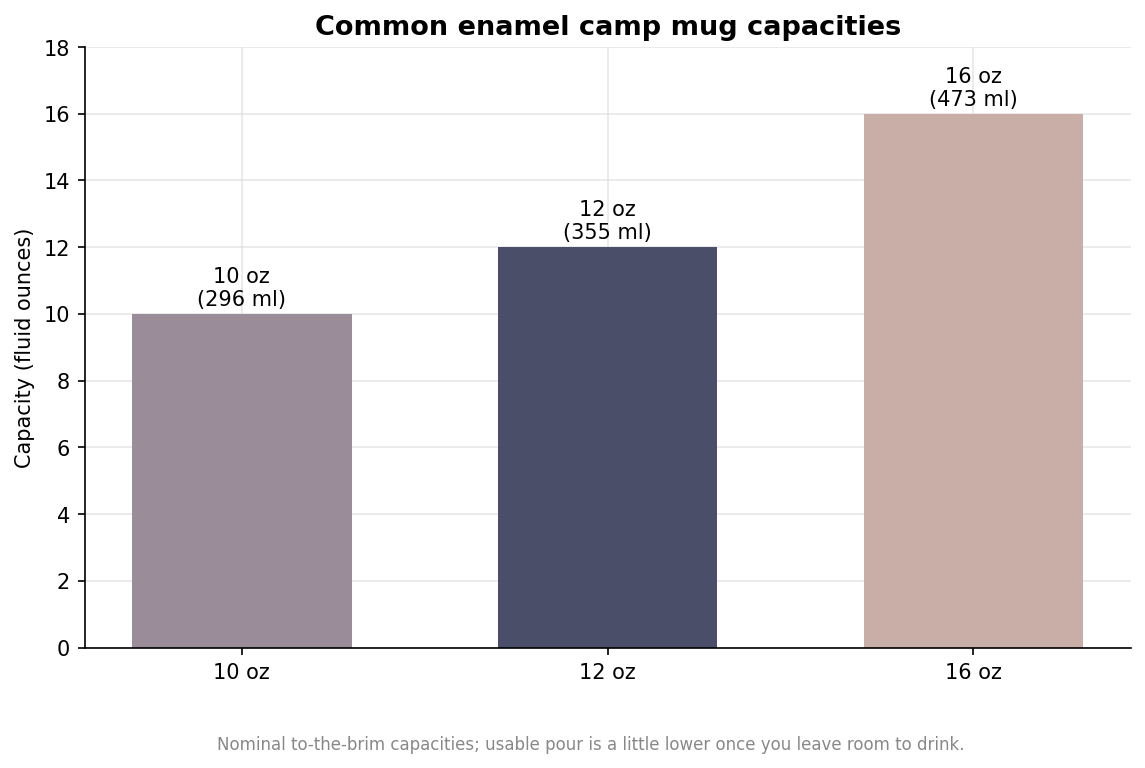
    Bar chart of common enamel camp mug capacities: 10 ounce (296 ml), 12 ounce (355 ml), 16 ounce (473 ml)
    The three standard enamel mug capacities, in ounces and milliliters.

    Where enamel costs you something

    The honest trade-off is heat. A classic enamel mug is single-walled, so it does not insulate — the body gets hot to hold with a fresh pour and the drink cools faster than it would in a double-wall vessel. The stainless rim also conducts heat, which some drinkers notice on the lip. If your use case is a long desk coffee or a hot drink someone nurses for an hour, double-wall stainless is the better tool: it keeps the drink warm and stays comfortable in the hand. And enamel is not indestructible — the glass coating can chip if the mug is knocked hard, exposing the steel to eventual rust at that spot. That is normal for the material, not a defect, but it is worth setting expectations with recipients. The weight difference across materials is real enough to matter for shipping a large order, as the second chart shows.
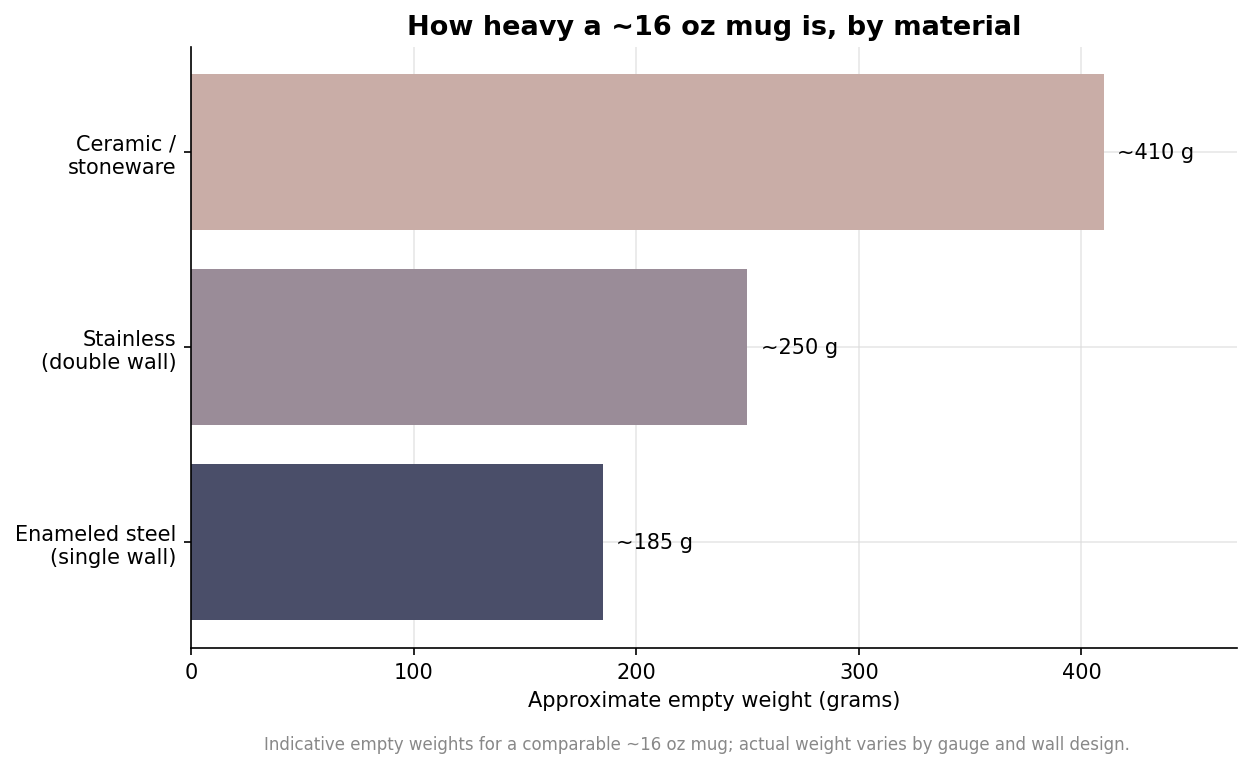
    Horizontal bar chart of approximate empty weight for a 16 ounce mug by material: enameled steel about 185 grams, stainless double wall about 250 grams, ceramic about 410 grams
    Enameled steel is the lightest of the three common camp-mug materials to ship.

    How it stacks up against ceramic and stainless

    Think of the three as different jobs. Ceramic stoneware is the heaviest and most breakable but feels the most premium on a cafe counter and holds heat moderately well, making it the choice for retail mugs meant to live on a shelf or a desk. Double-wall stainless is the performance option: insulated, near-indestructible, and comfortable with any temperature, but pricier per unit and without the handcrafted look. Enamel sits in the middle as the rugged, lightweight, character-forward pick — ideal for events, outdoor brands, camp stores, and giveaways where the look and the durability-to-weight ratio matter more than keeping coffee hot. None of them is “best”; the right answer is dictated by whether your buyer values appearance, insulation, or unbreakability.

    Care and the questions buyers actually ask

    Two practical questions come up on almost every enamel order: can it go in the dishwasher, and can it go on a flame? On washing, a fired-on enamel finish tolerates dishwashing well, but the more decoration relies on a lower-temperature printed layer, the more hand-washing extends its life; if the mugs are headed to a busy cafe or a campground, spec a fired design and tell recipients they can run them through a machine. On heat, traditional enameled steel can technically take direct flame or a campfire, which is part of its outdoor appeal, but the stainless-rimmed promotional versions are best treated as drinkware rather than cookware, and none of them belong in a microwave because of the steel core. Setting those two expectations up front prevents the most common complaints and the “my mug rusted” emails that really trace back to a chip left unwashed.

    Speccing an enamel order so it lasts

    If enamel is the right fit, a few specifics protect the order. Ask about the steel gauge — a heavier gauge resists denting and feels more substantial in the hand — and confirm the rim is stainless rather than enamel-coated, because a bare enamel rim is where chipping starts. For decoration, remember that a fired-on design bonds into the enamel and survives dishwashing, while a lower-temperature printed or transfer logo can gray or wear over time, so match the method to how the mug will be washed. Keep artwork clear of the rim and handle, and request a pre-production sample on the actual mug before a big run, since enamel colors shift from what you see on screen. Get the gauge, the rim, and the decoration method right, and an enamel mug does exactly what it is meant to do: look the part, take a beating, and keep a brand in someone’s hand trip after trip.
  • Which Enamel Mug Style Fits Your Use Case: Size, Rim, and Gauge

    Which Enamel Mug Style Fits Your Use Case: Size, Rim, and Gauge

    An enamel mug is a simple object with a surprising number of decisions hidden inside it. Two mugs that look identical in a product photo can differ by a size that changes who wants to carry it, a rim that decides whether the lip chips in a year, and a steel gauge that separates a mug someone keeps for a decade from one that dents in a drawer. The way to get the right one is to start from where the mug will actually be used and work backward to the specification.

    Size decides the use before anything else

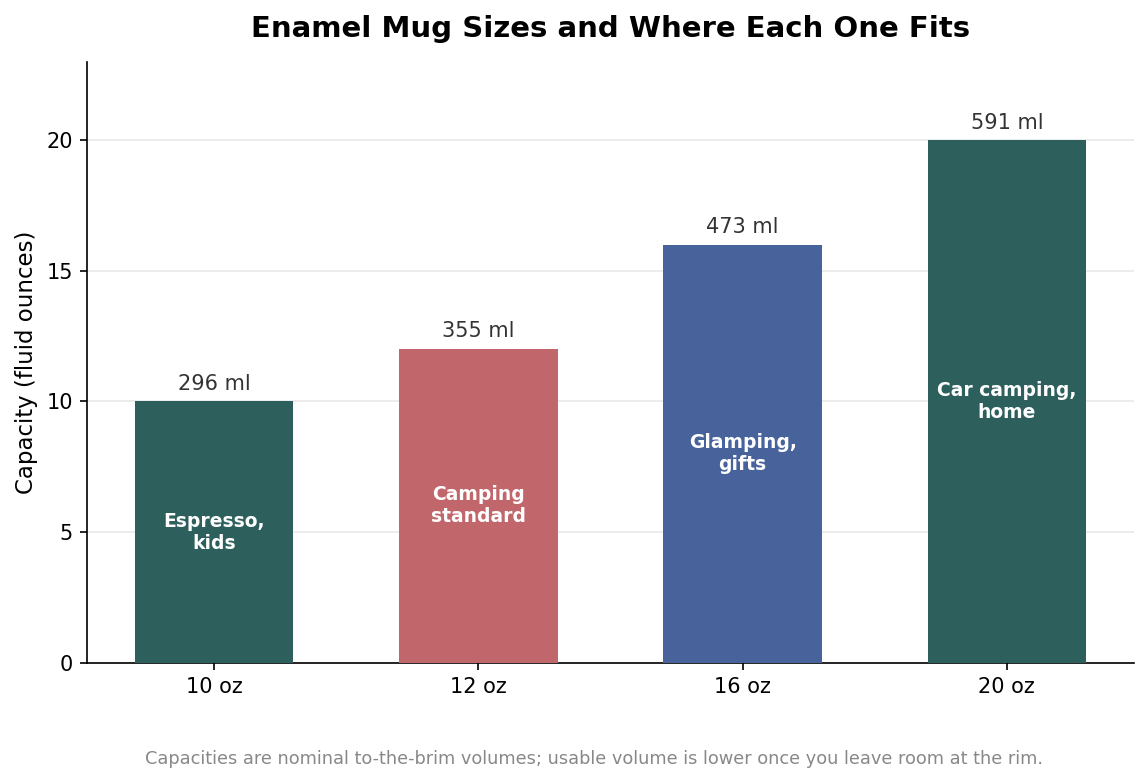
    Capacity is the first fork in the road because it quietly sorts the whole market. A 12-ounce mug, roughly 355 milliliters, is the camping standard: it fills once from a small pot, packs densely for shipping, and is the size most outdoor buyers reach for. A 16-ounce mug, about 473 milliliters, reads as a lifestyle or gift item and suits glamping, cafe merchandise, and anything meant to sit on a desk rather than a trail. Ten-ounce mugs work for espresso, kids, and tasting events, while 20-ounce and larger sizes drift into car camping and home decor, where weight and pack size stop mattering. Remember that these are to-the-brim numbers; the comfortable pour is always a little less once you leave room at the lip.

    Bar chart of enamel mug capacities from 10oz to 20oz with milliliter equivalents and the main use case for each size
    Capacity sorts the market: 12oz is the camping standard, 16oz the gift and cafe size.

    The rim is a durability decision, not a style one

    Buyers tend to treat the rim as a color choice, but it is the part of the mug that fails first, so it deserves more thought than the artwork. A rolled rim folds the enamel-coated steel over on itself, and it is the classic camp-mug look. Its weakness is that the fold is the hardest place to coat evenly, and a poorly made rolled rim leaves bare metal at the very edge that meets your mouth, which is exactly where chipping and rust start. A well-made rolled rim solves this with a tighter curve and better frit, and it can be color-matched to a Pantone for a branded color rim. A stainless steel rim takes the opposite approach: it caps the lip with bare, un-enameled stainless that cannot chip because there is no enamel there to chip. It sacrifices the all-over color look for a lip that survives dishwashers and daily knocks. Choose a stainless rim when the mug will be used hard and a color-matched rolled rim when appearance leads and the maker can prove clean edge coverage.

    Gauge is the number that separates a keepsake from a giveaway

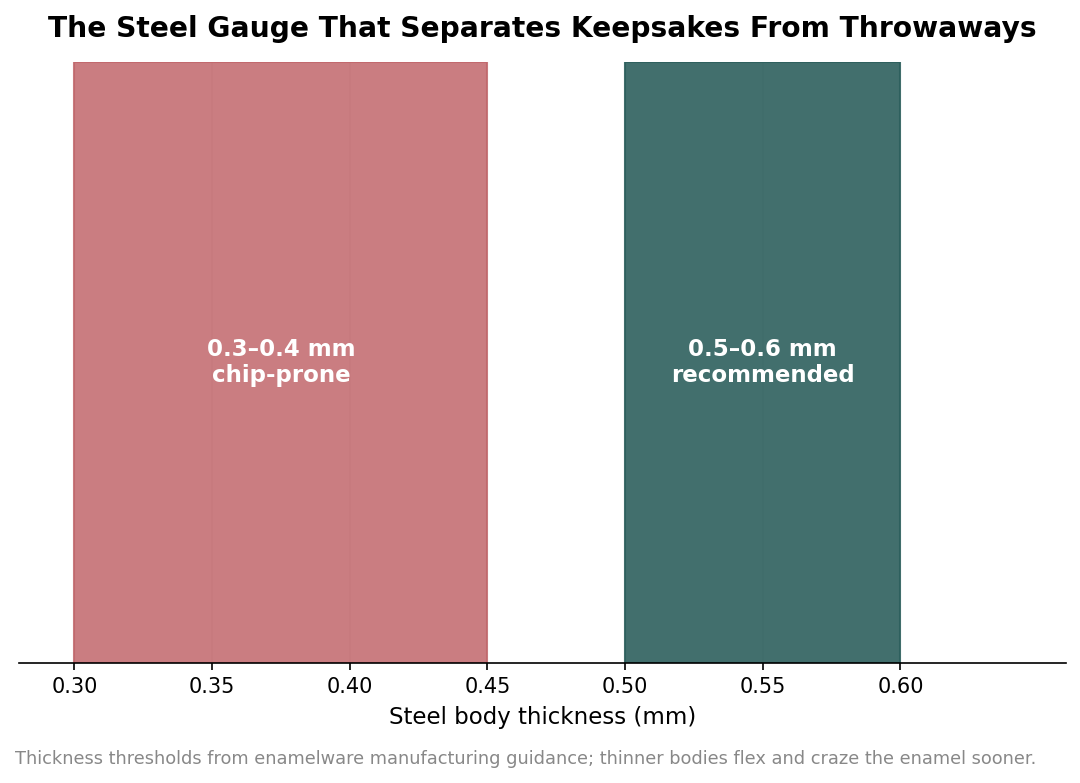
    The steel body thickness is the single most reliable predictor of how long an enamel mug lasts, and it is the spec most order forms omit. Enamel is glass fused onto steel, and glass cracks when the metal underneath it flexes. A thin 0.3 to 0.4 millimeter body flexes easily, so the enamel crazes and chips sooner, especially at the rim and base. Manufacturing guidance points to 0.5 to 0.6 millimeter steel as the threshold where the body is stiff enough to protect the enamel through normal use. Heavier gauge costs more and weighs more, which is why giveaway mugs cut it and heirloom mugs do not. If a supplier will not state the gauge in millimeters, treat that silence as a thin-steel answer.

    Number line showing enamel mug steel body thickness with a chip-prone 0.3 to 0.4mm zone and a recommended 0.5 to 0.6mm zone
    Steel gauge predicts lifespan: below about 0.45mm the enamel chips sooner.

    Finish and shape round out the choice

    Once size, rim, and gauge are settled, the finish is mostly about the message. A speckled finish, where flecks of a second color are fired over the base coat, reads as heritage and outdoors, and it hides small marks better than a flat solid color. A clean solid color reads as modern and retail, and it shows fine fired-print detail more crisply. A handleless tumbler drops the handle for a stackable, packable cup that suits tasting flights, cocktail service, and tight camp kits, at the cost of being hot to hold with a full pour of coffee. None of these finishes changes durability much on their own; they change who the mug appeals to, which is the point of a branded piece.

    Heat is the one performance trait buyers underestimate. Enamel over steel conducts heat readily, so a mug filled with a fresh pour gets hot at the wall and hotter at the rim, and a thin-gauge body heats and cools faster than a heavy one. That is a genuine advantage on a cold morning, when you want the mug to warm your hands, and a nuisance at a tasting table, where a handleless tumbler of hot coffee is hard to pick up. The same conductivity means enamelware is not made for a microwave, since the steel core is metal, and while most enamel mugs tolerate a dishwasher, a rolled rim with any exposed metal will rust there before an all-stainless lip will. Factor the serving temperature and the washing routine into the style choice, not just the look.

    Matching the mug to the job

    For a campground, outfitter, or outdoor brand, the answer is usually a 12-ounce, 0.5 to 0.6 millimeter, stainless-rim mug in a speckled finish: it packs cheaply, survives the use, and looks the part. For cafe or retail merchandise that customers pay for, a 16-ounce mug with a color-matched rolled rim and a crisp fired print earns its shelf price on looks and hand-feel. For weddings and events, where the mug is a favor that photographs well and gets used a few times, a lighter rolled-rim mug in a custom color is a reasonable place to save. For corporate gifting, spend on gauge and a stainless rim, because a mug that chips within a quarter does the brand more harm than no mug at all. In every case the sequence is the same: pick the use, let it set the size, then buy the rim and the gauge that will survive it. The finish is the last and most forgiving decision, not the first.

  • Are Custom Enamel Mugs Safe? Microwave, Dishwasher, Heat, and Lead, Explained

    Are Custom Enamel Mugs Safe? Microwave, Dishwasher, Heat, and Lead, Explained

    Enamel mugs sit in an odd spot. They look like rugged, throw-them-in-a-pack camp gear, yet they carry a coating that is closer to glass than to metal. That combination is exactly why the safety questions come up so often: people want to know whether they can microwave one, run it through the dishwasher, set it on a camp stove, or trust it with a child’s hot chocolate. The short answers are mostly reassuring, but the reasons behind them are worth understanding before you order a batch with your logo on the side.

    This guide walks through the four questions that actually decide whether an enamel mug is safe for the way you plan to use it: heat, the microwave, the dishwasher, and what the metals in the coating are allowed to do. None of it requires a chemistry background, and all of it is easy to check with a supplier before you commit.

    The microwave is the one hard no

    Keep enamel mugs out of the microwave, without exception. An enamel mug is a steel body with a fused glass coating on both faces. The steel is what makes it durable and campfire-ready, and it is also what makes a microwave a genuine hazard. Metal reflects microwaves rather than absorbing them, and thin or chipped edges can concentrate the field enough to arc, spark, and damage the oven, or worse. This is not a cautious manufacturer covering itself; it is the same reason you do not put a fork in a microwave. If your use case involves reheating drinks at a desk, an enamel mug is the wrong tool, and no coating quality changes that.

    The flip side is that the steel core is a real advantage everywhere else heat is involved, which is where most of the confusion starts.

    Heat, hot drinks, and open flame

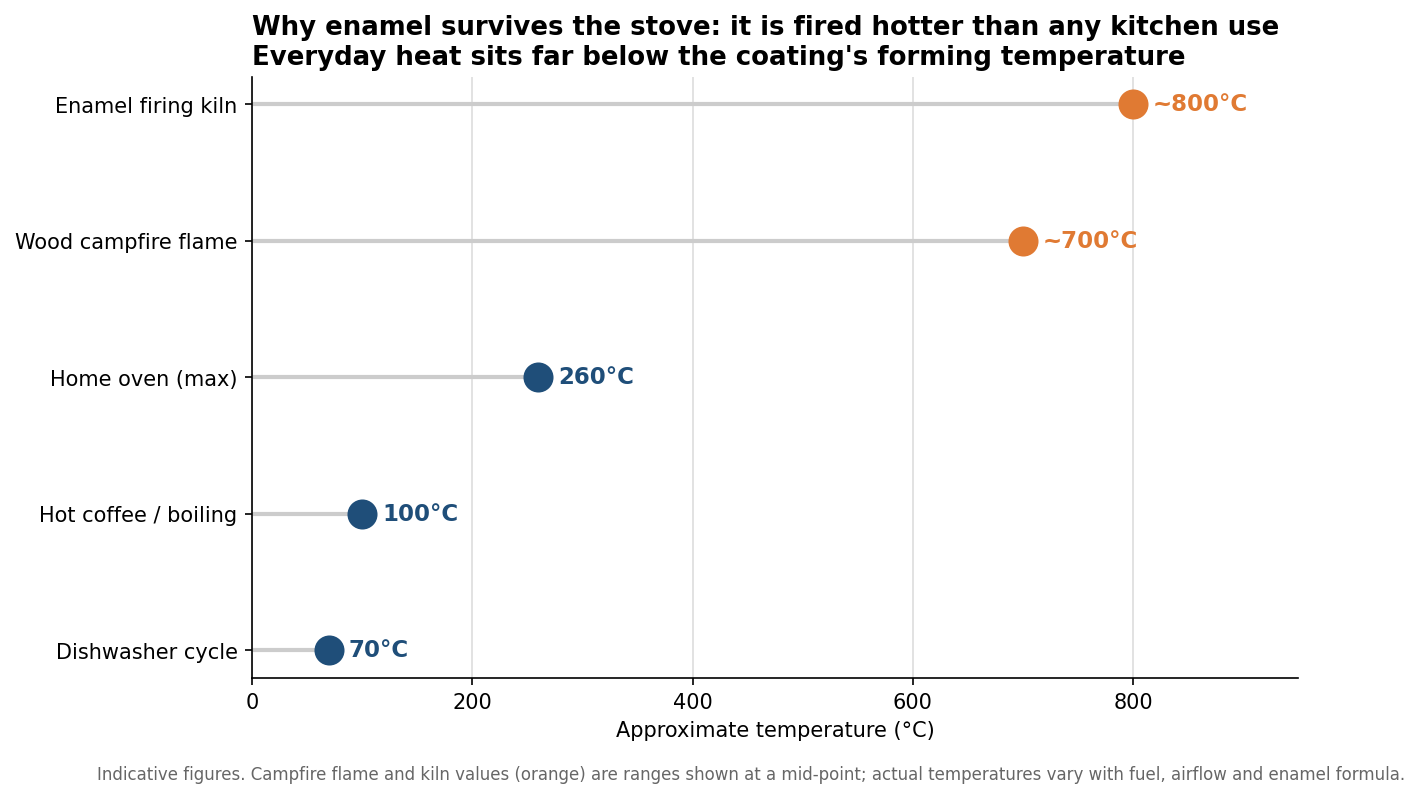
    Enamel is formed by firing powdered glass onto steel at roughly 750 to 850 degrees Celsius, or about 1,380 to 1,560 Fahrenheit. That single fact answers most heat questions at once: nothing you do at a campsite or a kitchen counter comes close to the temperature that created the coating in the first place. Boiling coffee, a dishwasher cycle, a hot oven, even a wood fire all sit well below the forming temperature, which is why a well-made enamel mug can go straight onto a camp stove or into the coals to boil water.

    Dot plot of temperatures showing dishwasher, hot coffee, oven, campfire and enamel firing kiln
    Everyday heat sits far below the temperature at which the enamel coating is fired onto the steel.

    The practical caveats are about handling rather than the coating failing. Steel conducts heat quickly, so a mug heated on a flame gets hot all over, including the rim and handle, far faster than a ceramic mug would. Expect to need a cloth or glove. The other real risk is thermal shock at the extremes: pouring boiling liquid into a mug straight from a freezer, or plunging a fire-hot mug into cold water, stresses the coating and can start a crack. Let a mug come back toward room temperature before you wash it. Treated sensibly, the heat tolerance is one of the format’s genuine strengths, not a liability.

    Dishwashers and everyday wear

    Enamel mugs are dishwasher safe, with a caveat about appearance rather than safety. The fused-glass surface is non-porous and shrugs off detergent and hot water. What dulls an enamel mug over time is mechanical: abrasive powders, scouring pads, and mugs knocking against each other or the rack. Fired glass is hard but brittle, so a sharp impact against another item is the most common way a rim chips. If you are buying mugs for a cafe or a rental fleet that will see daily machine washing, that is worth designing around, either by spacing them in the rack or accepting that heavy commercial use will show cosmetic wear at the rim first.

    Hand washing with a soft sponge is gentler and keeps a printed rim or logo looking sharper for longer, but it is a preference, not a requirement. Once a chip does happen, the exposed steel can develop a spot of surface rust; keeping mugs dry between uses slows that considerably.

    Lead, cadmium, and what “food safe” means

    This is the question that deserves the most care, because the honest answer is that it depends on how the mug was made, not on the fact that it is enamel. Enamel itself is inert fired glass, and a properly formulated coating leaches essentially nothing. The historical concern is with lead and cadmium, which were once used in glazes and colorants and can migrate into acidic drinks like coffee if a coating is poorly made or heavily decorated with the wrong pigments.

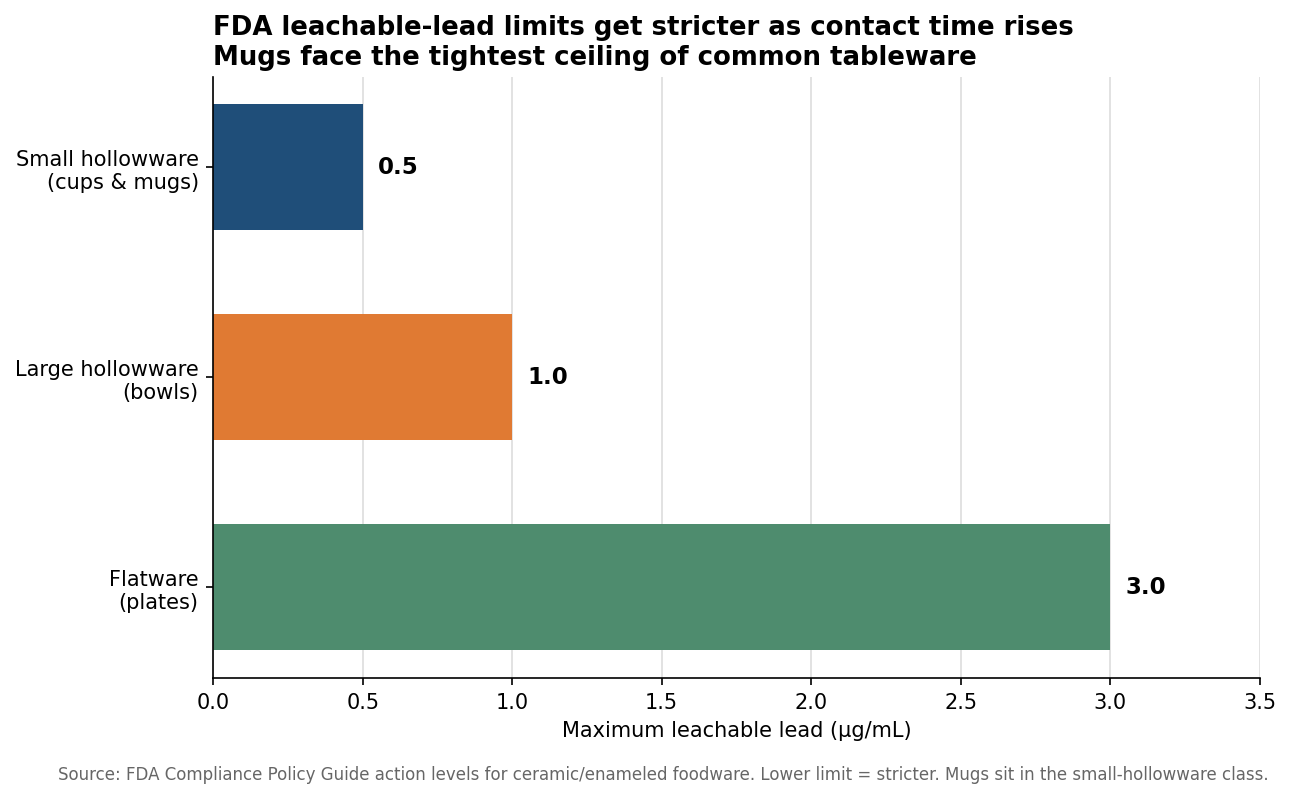
    In the United States, the FDA sets action levels for how much lead a piece of foodware may leach in a standardized acid soak, and the limit tightens as the food-contact time gets longer. Mugs and cups fall into the small-hollowware class, which carries the strictest of the common ceilings.

    Bar chart of FDA leachable-lead limits: flatware 3.0, bowls 1.0, cups and mugs 0.5 micrograms per milliliter
    Mugs fall in the small-hollowware class, which carries the strictest common lead limit.

    Cadmium is regulated separately and tends to matter most in bright red, orange, and yellow decoration, which is exactly the sort of eye-catching interior color a branded mug might use. The takeaway is not to avoid color; it is to buy from a supplier who can confirm the mug meets FDA limits and is made without added lead or cadmium, and to be a little more diligent when the design calls for vivid glazes on the drinking surface. In California, Proposition 65 adds a separate warning requirement, so reputable suppliers to that market can usually speak to it directly. Ask for the compliance statement in writing; a manufacturer that makes food-contact enamel will have one ready.

    Specifying a mug that stays safe and looks right

    Most of the safety story comes down to buying a genuinely well-made mug and then using it as intended, so it pays to specify a few things up front. Confirm the food-contact compliance first, ideally a plain statement that the mug meets FDA leachable-metal limits and is lead- and cadmium-free on the drinking surface. Match the decoration method to the wear you expect: a fired-on design becomes part of the glass and survives dishwashers and campfires, while a lower-temperature printed or transfer decoration can look excellent but is more vulnerable at the rim and under abrasion. Think about where the color goes, keeping the most saturated pigments away from the lip and interior if you want the simplest compliance path.

    Handled this way, an enamel mug is one of the safer and more durable drinkware formats you can put a brand on. Keep it out of the microwave, let it cool before washing, treat the rim as the vulnerable edge it is, and buy from someone who can show you the compliance paperwork. Do those four things and the coating that makes these mugs look fragile turns out to be the reason they last.

  • Why Enamel Mugs Chip (and What Actually Prevents It)

    Enamel does not chip because it is badly made. It chips because it is glass, and glass behaves in predictable ways.

    The rim takes almost all of it

    The lip is knocked against taps, stacked against other mugs and dropped rim-first. If there is glass at that point, it will eventually lose.

    A rolled rim removes the glass rather than trying to toughen it. The steel is folded over on itself and left bare, so the impact point is stainless. It is not a premium feature and it should be standard on anything sold for daily use.

    The other cause is the steel, not the glaze

    Coatings cannot bend. When thin-gauge steel dents, the enamel over the dent has nowhere to go, so it crazes into fine cracks and then lifts away in a flake.

    This is why identical glazes behave differently on different mugs, and why a heavier gauge is the real durability upgrade in a commercial room. The chip you see is the last step in a process that started with a dent.

    What a chip actually means

    Under the enamel is mild steel, so an exposed chip will develop a rust spot. It is not dangerous and it is not going to spread under the surrounding glaze, but it will look worse over time and it is where most mugs get retired from front-of-house.

    Dry chipped mugs properly rather than leaving them wet in a rack, and they last considerably longer in that state.

    What does not help

    A thicker single coat. Coat count and coat thickness are not the same thing, and a single heavy layer is more prone to crazing than a ground coat plus covers.

    Buying a heavier mug for a shelf. If it is not being dropped, gauge is money spent on freight.

    Anything described as a protective coating over the enamel. Enamel is glass; there is nothing to protect it with that is harder than it is.

  • Fired vs Printed: Why Branded Mugs Go Gray

    This is the most expensive mistake in the category, and it is invisible at the point of purchase.

    What firing does

    Enamel ink is screen printed onto the mug, or applied as a decal, and the whole thing goes back through the kiln. At temperature the ink vitrifies — it becomes glass and fuses with the glass beneath it.

    After that there is no layer to come off, because there is no layer. The mark is part of the surface. Commercial dishwashers, bleach and abrasive pads make no difference to it.

    What the cheap method is

    A low-temperature print or a lacquer applied on top of finished enamel. It cures rather than vitrifies, so it is a film sitting on a very smooth glass surface.

    It photographs perfectly, survives a domestic sink, and degrades under repeated hot commercial cycles. In a cafe running mugs twice a day, expect it to look tired within a season and gray within a year.

    How to tell them apart

    Fingernail across the edge of the print. Fired is flush; applied has an edge.

    You can also ask what temperature the decoration is cured at. A fired enamel print goes back to kiln temperature. Anything described in terms of drying or curing at low heat is not fired.

    Designing for a fired print

    There is a minimum stitchable line width in embroidery and a minimum printable one here. Hairline rules close up and very small type fills in. Open the artwork out rather than scaling it down.

    Choose colors from fired references. Enamel colors shift in the kiln, so a screen match or a printed swatch will mislead you. We fire a sample and post it before the run, which is slower and is the only way to actually know.

  • The Complete Buyer’s Guide to Custom Enamel Mugs

    Enamel mugs are bought from a photograph and judged after two hundred dishwasher cycles. These four questions decide the second part.

    First, is it actually enamel?

    Vitreous enamel is powdered glass fused to steel in a kiln. Powder-coated steel is paint baked at a much lower temperature. Both get called enamel and they look the same new.

    Real enamel is oven safe and glassy to the touch, and a spoon will not scratch it. Painted steel scratches, is not oven safe and will not survive a commercial dishwasher. If a supplier will not say which one they are quoting, that is your answer.

    Ask what happens at the rim

    Almost every chip starts at the lip, because that is what gets hit. A rolled rim folds the steel over on itself and leaves bare stainless at that point, so there is no glass there to chip.

    A colored rim is enamel taken over the lip. It is the better-looking finish and the more fragile one. Both are legitimate; only one of them is usually explained.

    Ask how many coats

    A proper build is a ground coat that bonds to the steel plus one or more cover coats. A single direct-on coat is thinner, cheaper and chips sooner.

    Nobody volunteers this number. Ask for it and put it on the purchase order, and you have made the single most useful comparison between two quotes that otherwise look identical.

    Match the gauge to the room

    Enamel usually fails because the steel underneath moved. A thin mug dents when it is dropped into a bus tub and the glaze over the dent crazes and lifts.

    For commercial service, buy heavier gauge. For a shelf, a gift box or a homeware line, do not — the extra weight costs money in freight and nobody will ever notice the benefit.

    And check the logo was fired

    Run a fingernail over the edge of the print. A fired mark is flush, because it has vitrified into the surface. An applied print has an edge you can feel.

    This is the difference between branding that outlasts the mug and branding that is patchy by the second winter.

  • Hello world!

    Welcome to WordPress. This is your first post. Edit or delete it, then start writing!